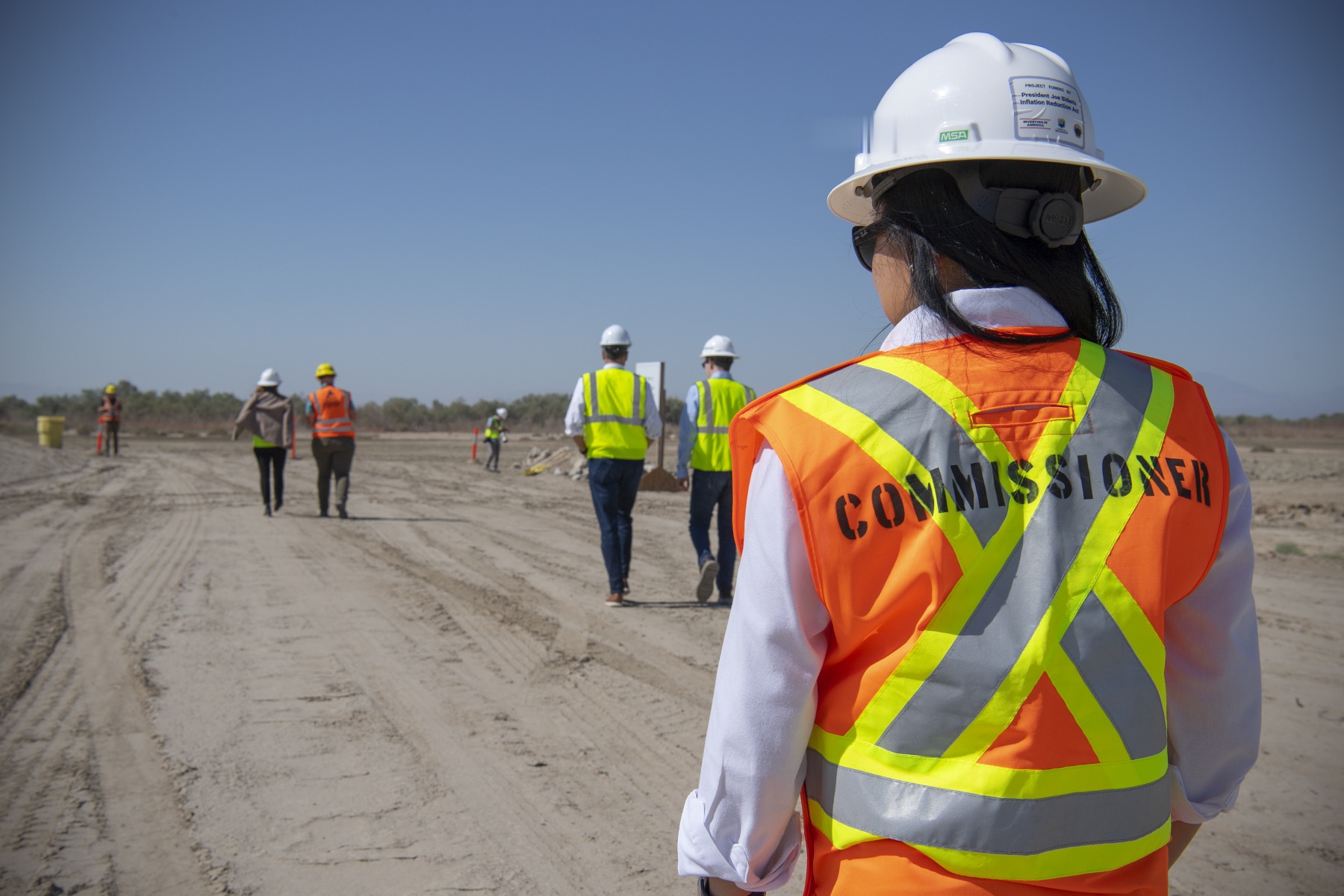
Civil engineer. Legislative architect. Federal agency head.
The advisor for decisions where consequences are real.
Camille Calimlim Touton advises leaders facing consequential decisions in water, infrastructure, and natural-resource systems. She has led these decisions at scale — where legal frameworks, political realities, operational constraints, and human consequences all converge at once.
Most advisors understand one part of that equation. She has lived inside all of them. That is what makes this firm different.
Before leading the Bureau of Reclamation, Camille Touton spent fifteen years as a Professional Staff Member on Capitol Hill — in the engine room where federal water law is actually written. When a project encounters federal constraints, water rights frameworks, or funding authorization requirements, her experience drafting and negotiating federal water legislation provides a rare level of context.
She began her Hill career in the office of Senate Majority Leader Harry Reid (D-NV), gaining a foundational education in Western water politics and federal decision-making. She went on to advise ranking members of the House Natural Resources Committee — including Reps. Nick Rahall, Ed Markey, and Peter DeFazio — before serving on the Senate Energy and Natural Resources Committee and the House Committee on Transportation and Infrastructure. A constant throughout her tenure on the Hill was her work for Rep. Grace F. Napolitano (D-CA), a premier Congressional water expert.
Her most significant legislative work of this period was the Claims Resolution Act of 2010 — landmark legislation settling decades of federal-Tribal litigation over water rights in New Mexico, Montana, and Arizona. The Act authorized billions in water infrastructure, converting legal entitlements into actual delivery systems for communities that had previously relied on hauled water. As lead Democratic staff negotiator for the water provisions of the John D. Dingell, Jr. Conservation, Management, and Recreation Act (Public Law 116-9), she secured enactment of the Reclamation Title Transfer Program — a framework she would later put to use, delivering 8 title transfer projects as Commissioner.
In 2019–2020, she led the staff efforts for the resiliency provisions as part of the Water Resources Development Act of 2020, ensuring that Army Corps of Engineers projects would account for changing hydrology and extreme weather in their design phase. Those criteria continue to shape how major water and infrastructure projects are planned today.
Confirmed as the 24th Commissioner of the U.S. Bureau of Reclamation in 2021, Touton assumed leadership of a 6,000-person agency managing the water infrastructure of the American West — 492 dams, 337 reservoirs, and systems serving more than 40 million people and 10 million acres of farmland. She did it during the most severe megadrought on the Colorado River in over a millennium.
In June 2022, during congressional testimony, she outlined the need for the seven Colorado River Basin states to voluntarily reduce consumptive use by 2 to 4 million acre-feet. Decisions at that scale require simultaneous understanding of law, infrastructure, stakeholder dynamics, and political consequence.
At the same time, Touton oversaw the deployment of nearly $12 billion through the Bipartisan Infrastructure Law and Inflation Reduction Act — advancing investments in aging infrastructure, large-scale water reuse such as Pure Water Southern California, and long-delayed rural delivery systems including the Arkansas Valley Conduit. These investments required aligning funding with policy, operations, and implementation in real time.
She also led U.S. engagement on the U.S.–Mexico Colorado River Minute 330 — a bilateral agreement that included 400,000 acre-feet of conservation by Mexico as part of a coordinated drought response. By 2026, the Lower Basin states and Mexico had jointly conserved 1.6 million acre-feet, reflecting a level of transboundary coordination achieved under sustained operational pressure.
Clients who work with this firm are typically facing one of three kinds of decisions:
Engagements are principal-led. Camille Touton works directly with clients. The judgment applied to each engagement reflects experience leading through the most complex water decisions in the country.
The firm takes a limited number of engagements at a time. This structure allows for depth, focus, and sustained attention to the decision at hand. The work is grounded in careful application of judgment to the problem in front of you.
Engagements begin with a conversation about the decision you are facing. The structure follows from that point. Each engagement is defined by a clear outcome aligned to the decision itself.
Senior-led. Principal-driven. Built for the complexity you're actually facing.